
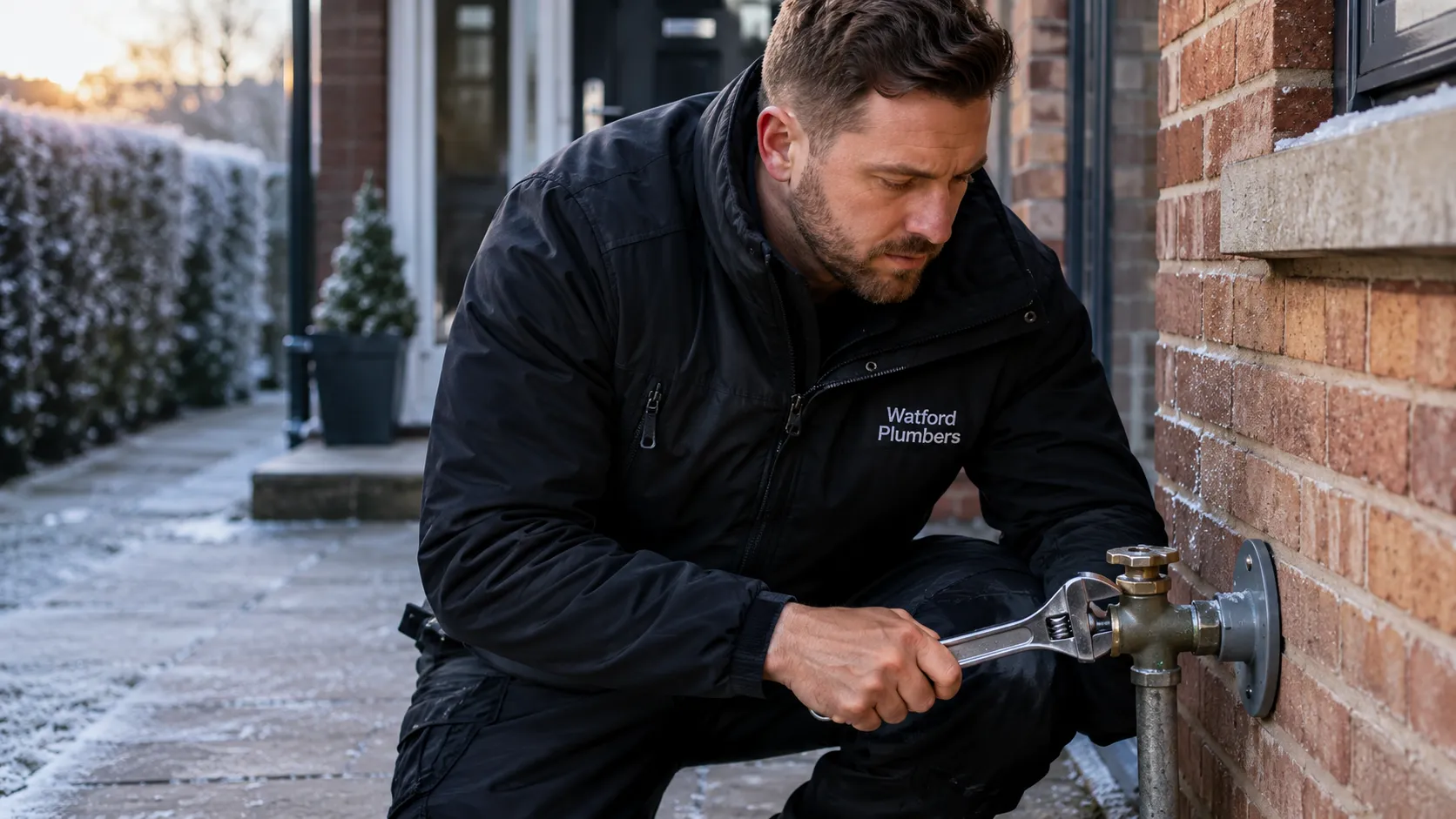
A family in a Victorian terrace on Nascot Wood Lane, WD17, woke on the coldest morning of the year to find every radiator stone cold. The boiler display showed a lockout code, and with two young children in the house and the outside temperature at minus 2, working out what to do next could not wait for a normal appointment slot.
Watford Plumbers & Heating Engineers takes calls like this on almost every cold snap. A boiler breakdown in winter is stressful, but most cases follow a small set of predictable causes, and knowing the right first steps can get you heat back faster or tell you exactly what to say to an engineer.
This guide covers the checks you can safely do yourself, the warning signs that mean you need a Gas Safe engineer immediately, and how to stay safe and warm while you wait.
Quick Answer
|
Featured Snippet -- Direct Answer |
|
If your boiler breaks down in winter, check the pressure gauge reads between 1.0 and 1.5 bar, look for ice on the external condensate pipe, and try a reset following your manual. If a lockout code persists or you smell gas, stop and call a Gas Safe registered engineer straight away. |
Signs Your Boiler Has Actually Broken Down
A genuine boiler breakdown is more than the house feeling a little cool. Look for the specific signs: no heat and no hot water together, a lockout light or fault code on the display, the boiler firing up then cutting out repeatedly, or complete silence and a blank display. A single cold radiator with the rest of the house warm usually points to a radiator needing bleeding, not a boiler fault.
Before assuming the worst, check your thermostat is set above room temperature and the programmer has not switched to an "off" period. It sounds obvious, but a knocked thermostat dial is a common false alarm call in WD17 and WD18 homes.
A single cold radiator with the rest of the house warm is a different problem again, usually trapped air needing a radiator bleed rather than anything wrong with the boiler itself. If every radiator is cold and the hot water has also stopped, that combination almost always points to the boiler rather than an individual radiator fault.
Why Boilers Break Down More Often in Winter
Winter is when boilers fail most often, and one cause dominates. The condensate pipe, a white plastic pipe that carries acidic waste water from a modern condensing boiler outside, can freeze solid in sustained cold weather, especially where it runs along an external wall on older Victorian or Edwardian conversions in Nascot Wood and central Watford. A frozen condensate pipe blocks the boiler's safety system and forces it into lockout.

Cold weather also means your boiler works far harder and for far longer than in summer, and any existing weakness, such as a worn pump, a slow pressure leak, or scale from Watford's hard water building up on the heat exchanger, is more likely to tip into a full breakdown under that extra demand.
First Checks You Can Safely Do Yourself
Run through these checks before calling an engineer. They take five minutes and often solve the problem outright.
1. Check the pressure gauge. It should read between 1.0 and 1.5 bar. If it is below 1.0, you can usually top it up yourself using the filling loop, following the steps in your boiler manual.
2. Check the programmer and thermostat. Confirm the system is set to heating on, and the thermostat is set higher than the current room temperature.
3. Look at the boiler display for a fault or lockout code. Note the exact code before you do anything else, since it tells the engineer, or you, exactly what has failed.
4. Look outside for the condensate pipe. If you can see visible ice on the external white plastic pipe, this is very likely your cause.
5. Try a single reset. Most boilers have a reset button; press it once and wait several minutes. Repeated resetting can make some faults worse, so try it once only.
How to Thaw a Frozen Condensate Pipe Safely
Thawing a frozen condensate pipe is safe to attempt yourself in most cases. Locate the pipe outside, usually a white plastic pipe running from the boiler to a drain or gulley at ground level, and pour warm water, not boiling water, over the section nearest the ground where ice typically forms first. A hot water bottle wrapped around the pipe works just as well and is gentler on the plastic.
Once the pipe is clear, go back inside and reset the boiler. Heat should return within a few minutes. If the pipe refreezes or the same lockout code returns, the freeze may be further along the pipe than you can reach, or the underlying fault may be something else entirely.
|
Warning |
|
Never pour boiling water onto a frozen condensate pipe. The sudden temperature change can crack the plastic, turning a simple freeze into a leak that needs a full pipe replacement. If ice keeps returning after thawing, this is a job for a professional rather than repeat attempts. |
When to Call a Gas Safe Engineer Immediately
Call a Gas Safe registered engineer immediately if you smell gas, if a carbon monoxide alarm sounds, if the pilot light will not relight after following the manual, or if the same fault code returns after a reset and a condensate check. Attempting gas work without Gas Safe registration is a criminal offence under the Gas Safety (Installation and Use) Regulations 1998, not a preference, a legal requirement, so component-level faults such as a failed ignition lead or PCB are never a DIY job.
Fault codes are also useful evidence for the engineer. Codes such as EA, E9, or 227 on Worcester Bosch boilers point to specific ignition or sensor faults, and having the exact code ready when you call means a faster, more accurate diagnosis on arrival. Our engineers can typically reach WD17 and WD18 addresses within the hour for a genuine winter emergency.
It is worth knowing that the Gas Safe Register is the official list of engineers legally allowed to work on gas appliances in the UK, replacing the old CORGI scheme. Checking an engineer's Gas Safe ID card before they start work, whether it is us or anyone else, takes seconds and confirms they are qualified to touch your boiler safely.
Carbon monoxide safety deserves particular attention during a winter breakdown. A working CO alarm should already be fitted near your boiler, and if it sounds at any point, treat it as seriously as a gas leak: open windows, leave the property, and call the National Gas Emergency Service on 0800 111 999 from outside. Our guide to carbon monoxide poisoning signs and boiler safety covers this in full detail.
Staying Warm and Safe While You Wait
While you wait, use portable electric heaters safely, keeping them clear of curtains, bedding, and away from bathrooms. Check on elderly relatives or neighbours nearby, since a cold home is a genuine health risk for older residents during a cold snap. If pipes elsewhere in the house have not frozen yet, opening under-sink cupboard doors can help warm air reach vulnerable pipework.
If a breakdown coincides with genuinely icy conditions elsewhere in the property, keep an eye on exposed pipework in lofts, garages, and under stairs cupboards too, not just the condensate pipe outside.
A frozen and then burst internal pipe caused by a prolonged cold snap is a far bigger job than a boiler reset, and our burst pipe emergency guide explains what to do if that happens alongside a boiler failure.
If you rent your Watford property, report a boiler breakdown to your landlord immediately in writing. Under the Landlord and Tenant Act 1985 Section 11, landlords must keep the heating installation in proper working order, and a total loss of heating in winter is generally treated as an emergency repair.
How to Stop Your Boiler Breaking Down Next Winter
Most winter boiler breakdowns are preventable with a little preparation before the cold arrives. Book your annual boiler service in early autumn rather than waiting for the first freeze, since a Gas Safe engineer will check the condensate route, pressure, and heat exchanger condition while there is still time to fix small issues.
Lag any exposed section of condensate pipe with purpose-made pipe insulation, particularly where it runs along an external wall on Victorian or Edwardian conversions. If your boiler has a frost protection setting, make sure it is switched on. It runs the heating briefly during very cold weather even when the house is unoccupied, preventing both a frozen condensate pipe and frozen internal pipework.

Power flushing is also worth considering as part of your pre-winter service if your radiators have been slow to heat up or make banging noises. Removing accumulated sludge and limescale from Watford's hard water restores efficient circulation and reduces the load your boiler is under during the coldest months. Our guide to what power flushing does for your boiler explains the full process.
Conclusion
Knowing the difference between a false alarm and a genuine winter breakdown, and having the pressure gauge, condensate pipe, and fault code checked before you call, gets Watford homes warm again faster and helps your engineer arrive prepared. Hard water and hard winters both put extra strain on an ageing boiler, so an annual service before the cold sets in remains the best protection WD17 and WD18 homeowners have.
If your boiler has broken down and the checks above have not brought the heating back, Watford Plumbers & Heating Engineers can get a Gas Safe registered engineer to your door quickly, day or night.
|
Get Help |
|
No heat this winter? Call Watford Plumbers & Heating Engineers on 07425 281 744 for emergency boiler repairs across WD17 to WD25, available when you need us most. |
Frequently Asked Questions
Why has my boiler stopped working in cold weather?
The most common winter cause is a frozen condensate pipe, the external plastic pipe that carries waste water away, which blocks and triggers a safety lockout. Increased demand and existing weaknesses, such as low pressure or hard water scale, also make breakdowns more likely during sustained cold snaps.
Can I thaw a frozen condensate pipe myself?
Yes, pour warm water, never boiling, over the visible section of pipe outside, or wrap it in a hot water bottle. Reset the boiler afterwards. If ice keeps returning or you cannot reach the frozen section, call a Gas Safe engineer rather than repeating the attempt.
Is a boiler breakdown a gas emergency?
Not usually, but treat it as one immediately if you smell gas or a carbon monoxide alarm sounds. Open windows, leave the property, and call the National Gas Emergency Service on 0800 111 999 from outside. A simple lockout or frozen pipe is not a gas emergency.
How long does an emergency boiler repair take in Watford?
Our engineers can typically reach WD17 and WD18 addresses within the hour for a genuine winter emergency with no heat or hot water. Having your fault code and pressure reading ready when you call speeds up diagnosis once the engineer arrives.
Should I turn my boiler off if it's not working?
Generally leave it switched on unless you smell gas, in which case turn it off at the isolation valve and call the emergency number immediately. Leaving it on with the frost protection setting active also helps prevent pipes freezing further while you wait for repair.
