
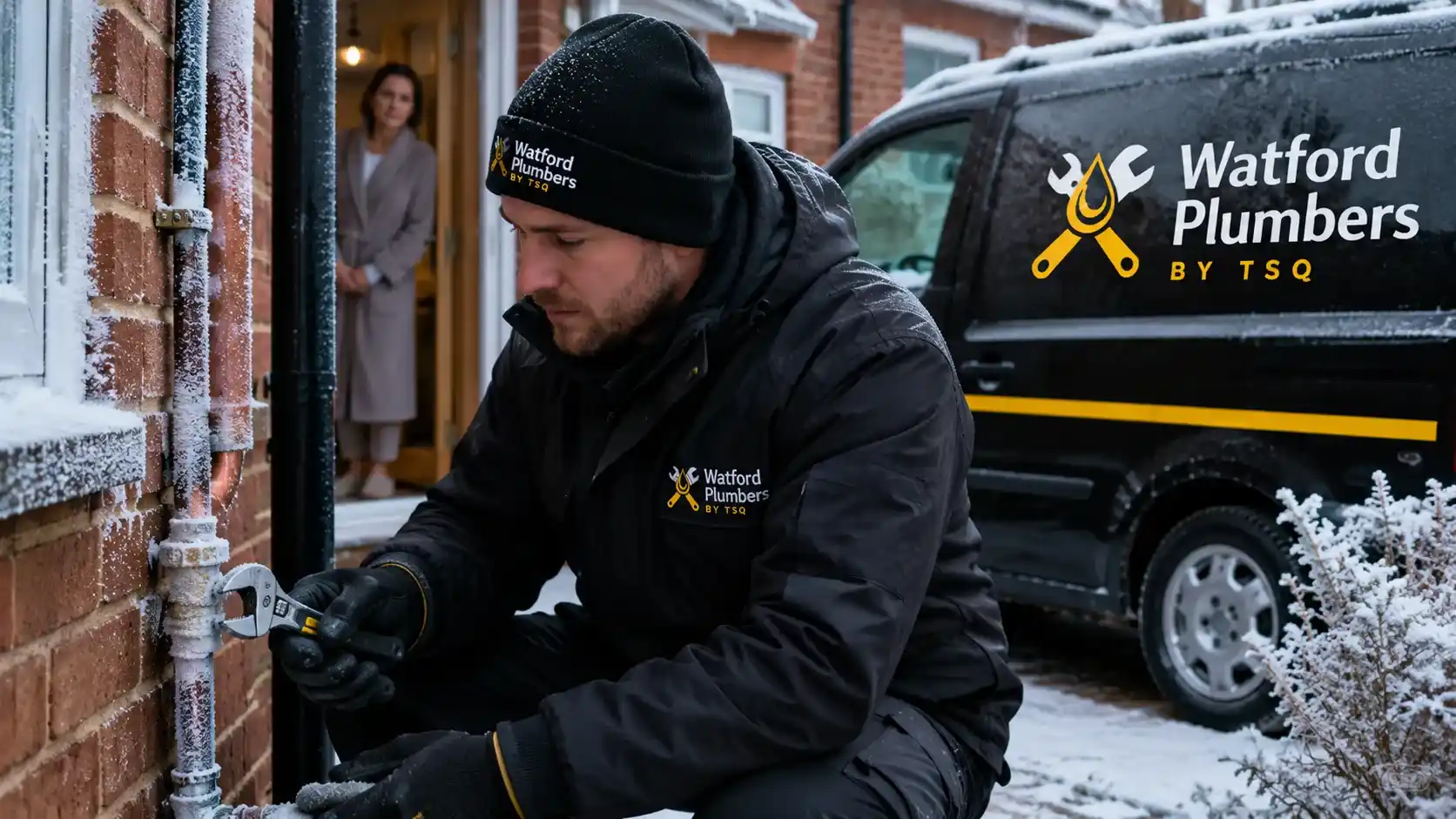
A homeowner in a 1930s semi in Oxhey, WD19, discovered no water from the kitchen tap on a January morning. The external supply pipe on the back wall had frozen overnight. They waited -- hoping it would thaw on its own. It did not. By midday, the pipe had split and water was pouring through the kitchen ceiling. The emergency repair and water damage bill came to over £480 -- easily preventable with a £12 foam lagging sleeve installed in autumn. Watford Plumbers & Heating Engineers attend frozen and burst pipe callouts across WD17, WD18, and WD19 every winter.
Frozen pipes are one of the most common winter plumbing emergencies in Watford. Properties in Nascot Wood and Oxhey are particularly at risk -- Victorian terraces and 1930s semis often have older copper pipework on exposed external walls, in unheated lofts, and below suspended timber floors where temperatures can drop sharply overnight.
This guide covers exactly what to do if you suspect a frozen pipe right now, how to thaw safely without causing a burst, and the straightforward steps to prevent it happening again. If your pipe has already burst, go straight to our burst pipe emergency guide and turn off your stopcock immediately.
|
Quick Answer: What to Do If You Have a Frozen Pipe |
|
Turn off your stopcock first. Then gently apply heat to the frozen section using a hair dryer on a low setting or a hot water bottle -- never a blowtorch. Work from the tap end toward the frozen section. Open the tap so water can flow as thawing begins. If the pipe has burst or water is leaking after thawing, call a local plumber immediately. Do not use electrics near standing water. |
Signs Your Pipe Is Frozen: How to Confirm the Problem
The most obvious sign is no water from a tap -- but only one or two taps, not all of them. If all taps stop working simultaneously, the cause is likely a different problem such as a mains supply interruption from Thames Water.
Check for these signs to confirm a frozen pipe:
• No water from a specific tap, or only a trickle
• A visible frost patch or ice on an exposed section of pipe -- particularly on external walls or in the loft
• A bulging or slightly discoloured section of pipework (indicates internal ice expansion -- high burst risk)
• Your boiler has stopped working on a cold morning -- this may indicate a frozen condensate pipe (covered in the next section)
• Pipes that were working yesterday but are silent today after overnight temperatures dropped to 0°C or below
In Watford properties, check external back walls, under sink units on external walls, in the loft, and in any unheated utility rooms first. These are the areas that freeze first in WD17 and WD19 homes.

Why Pipes Freeze in Watford -- and When They Burst
Water expands by approximately 9% when it freezes. Inside a sealed copper or plastic pipe, this expansion has nowhere to go -- it pushes outward against the pipe wall. The pipe itself does not usually split at the point of freezing. The split typically occurs slightly downstream, where pressure builds up between the ice blockage and a closed tap.
Watford properties face a specific combination of risk factors:
|
Risk Factor |
Why It Matters in Watford |
|
Victorian and 1930s property stock |
Older 15mm copper supply pipes on external walls in Nascot Wood and Oxhey have less protection than modern cavity wall pipework. |
|
Unheated lofts |
Many WD17 and WD19 homes have loft conversion planning but uninsulated loft spaces -- a prime freezing zone. |
|
Thames Water hard water |
Hard water causes mineral deposits inside pipes over time, narrowing the bore and making them more susceptible to blockage when ice forms. |
|
Sharp overnight temperature drops |
Watford typically sees overnight lows of -3°C to -6°C in January and February -- cold enough for exposed pipes to freeze within four to six hours. |
|
Absence during cold snaps |
Properties left unheated over Christmas or during winter holidays freeze faster. A heating timer set to 15°C overnight prevents this entirely. |
|
WARNING: When Burst Risk Is Highest |
|
The most dangerous moment is during thawing -- not during freezing. As ice melts, water pressure surges back through the pipe. If there is already a small crack or weakened joint from the freezing, this surge causes the split. This is why controlled, gradual thawing is essential. |
How to Thaw a Frozen Pipe Safely: Step-by-Step
Follow these steps in order. Do not skip step 1 -- this is the most common mistake homeowners make.
1. Turn off your stopcock (the main water isolation valve, usually under the kitchen sink or where the supply pipe enters the property). If the pipe bursts during thawing, this stops the flood.
2. Open the tap nearest to the frozen section. This releases pressure as the ice melts and lets water flow as soon as thawing begins.
3. Locate the frozen section. Feel along the pipe for a very cold section or visible frost. On external walls and in lofts are the most common spots in Watford homes.
4. Apply gentle heat using a hair dryer on the lowest setting, a hot water bottle wrapped in a cloth, or warm towels. Start from the tap end and work back toward the frozen section -- this allows water to escape as it thaws.
5. Never use a blowtorch, gas flame, or space heater placed directly against the pipe. These can cause pipe fittings to fail instantly and create a fire risk -- particularly around lagging or timber joists.
6. Turn the stopcock back on slowly once water begins to flow from the open tap. Check for drips or sprays along the pipe as pressure is restored.
7. If water leaks appear after restoring pressure -- turn the stopcock off again immediately and call a qualified plumber. The pipe has split.
|
Key Tip: No Hair Dryer? Try This |
|
Soak a cloth or towels in warm (not boiling) water and wrap them around the frozen section. Replace them every few minutes. It takes longer than a hair dryer but is completely safe and works effectively on most domestic copper pipe sizes. |
Frozen Condensate Pipe: What to Do When Your Boiler Goes Off
If your boiler has stopped working on a cold morning and is showing a fault code or lockout light, the most likely cause in winter is a frozen condensate pipe. This is a white plastic pipe (typically 32mm or 40mm diameter) that runs from the boiler to an outside drain, carrying acidic condensate water.
The condensate pipe is often the first pipe to freeze in a Watford home because it runs outside and carries water at near-ambient temperatures. It is not a gas or heating pipe -- it is safe for homeowners to thaw themselves.
To thaw a frozen condensate pipe:
8. Locate the external section of the white plastic pipe -- usually on the outside rear or side wall of the property.
9. Pour warm (not boiling) water over the frozen section. A kettle cooled slightly -- around 60-70°C -- works well. Do not use boiling water as this can crack CPVC fittings.
10. Once thawed, press the reset button on your boiler and wait 30 seconds for it to relight.
11. If the boiler does not relight after two reset attempts, call a Gas Safe registered engineer. Do not keep pressing reset repeatedly -- this can damage the boiler ignition system.
|
IMPORTANT: Gas Safe Registration Required for Boiler Internal Faults |
|
Thawing the external condensate pipe is safe for homeowners. However, if your boiler still fails to light after the condensate pipe is clear, the fault is internal to the boiler. Under the Gas Safety (Installation and Use) Regulations 1998, only a Gas Safe Register engineer may work on the internal components of a gas boiler. Our Gas Safe registration number is 574111. |
When to Call an Emergency Plumber in Watford
Most frozen pipes can be thawed by a competent homeowner following the steps above. Call a qualified plumber immediately in any of these situations:
• Water is leaking or spraying after you restore the stopcock -- the pipe has burst
• You cannot locate the frozen section or access it safely
• The frozen pipe is in a wall cavity, below a concrete floor, or in a location requiring tools to access
• Your stopcock is also frozen or will not turn -- do not force it
• Water has come through a ceiling, into a wall, or is pooling under the floor
• You have thawed the pipe but pressure has not returned after 20 minutes
Our engineers cover WD17, WD18, WD19, and surrounding Watford areas and typically respond within the hour to frozen and frozen pipe and burst pipe repairs in Watford. Call 07425 281 744 for same-day callouts.

How to Stop Pipes Freezing: Lagging, Heating and Watford-Specific Tips
Prevention costs a fraction of emergency repair. These are the measures that make the biggest difference for Watford homes -- particularly Victorian terraces in Nascot Wood and Edwardian properties in central WD17 where exposed pipework is most common.
|
Prevention Method |
Approximate Cost |
Effectiveness |
|
Foam pipe lagging (loft pipes) |
£10--£25 DIY |
Very high -- most cost-effective first step for WD17 and WD19 homes with exposed loft pipework |
|
Pipe lagging (external wall pipes) |
£15--£40 DIY or professional |
High -- particularly important for Victorian terrace properties in Nascot Wood |
|
Heating timer set to 15°C overnight |
No cost -- existing boiler setting |
Very high -- prevents freezing in all but the most severe conditions (-10°C+) |
|
Drain external taps and hose fittings in autumn |
No cost |
High -- external tap freeze is a very common winter problem across WD17--WD25 |
|
Insulate under-sink pipe in cold utility rooms |
£5--£15 DIY |
Medium -- useful in older properties with single-brick external walls |
|
Professional pipe survey and lagging service |
£80--£150 |
Very high -- identifies all at-risk pipe runs including those not visible without inspection |
Thames Water supply data confirms that Watford sits in one of the UK's hardest water areas. Over time, hard water from the Thames Water supply area deposits mineral scale inside pipe joints -- this can make older joints more brittle and increase the likelihood of a split if freezing occurs. Regular annual boiler servicing also includes a check on the condensate pipe routing -- ask your engineer to check that the external section is well insulated each autumn.
Summary
Frozen pipes in Watford are preventable with the right preparation -- but when they do occur, the speed of your response determines whether the outcome is a minor inconvenience or a major flood repair. Turn off the stopcock first, thaw slowly and carefully, and check for leaks before restoring full water pressure. If your boiler has also stopped, check the condensate pipe before calling an engineer -- it is often a simple 60-second fix.
For emergency plumbing in Watford -- including frozen pipes, burst pipes, and boiler lockouts -- call Watford Plumbers & Heating Engineers on 07425 281 744. Our Gas Safe registered engineers (574111) serve WD17, WD18, WD19, WD23, WD24, and surrounding areas. We aim to reach most Watford addresses within the hour.
|
Frozen Pipe in Watford? We're Here to Help |
|
Watford Plumbers & Heating Engineers provides same-day emergency response for frozen pipes, burst pipes, and winter boiler faults across WD17, WD18, WD19, and surrounding areas. |
|
Call us on 07425 281 744 -- or visit watford-plumbers.co.uk to book online. Gas Safe registered: 574111. |
Frequently Asked Questions
How do I know if my pipes have frozen?
Signs of frozen pipes include no water from taps, a visible frost patch on exposed pipework, or unusual gurgling sounds. Check under sinks, in the loft, and along external walls first. Pipes in unheated areas of a Watford home -- particularly Victorian terraces in Nascot Wood -- freeze most often during sharp overnight drops.
Is it safe to thaw frozen pipes myself?
Yes, if you follow the correct method. Turn off your stopcock first, then apply gentle heat using a hot water bottle or hair dryer on the lowest setting. Never use a blowtorch or open flame. Work from the tap end toward the frozen section. If you suspect a burst has already occurred, call a plumber before thawing.
At what temperature do pipes freeze in the UK?
Pipes can begin to freeze when outside temperatures drop to 0°C or below and stay there for six or more hours. Water inside exposed pipes in unheated lofts, garages, or external walls is most at risk. Watford typically experiences these conditions during December to February, with hard frosts most likely overnight.
Will my home insurance cover burst pipe damage?
Most UK home insurance policies cover sudden and accidental water damage from a burst pipe, but exclusions apply. Insurers may reject claims if damage resulted from lack of maintenance, leaving the property unheated, or failure to lag pipes adequately. Check your policy schedule before a claim and photograph all damage immediately.
How much does emergency frozen pipe repair cost in Watford?
Emergency callout costs in Watford typically range from £150 to £350 depending on time of day, the extent of the burst, and how accessible the pipework is. Loft pipe bursts with water damage take longer to repair and cost more. Booking a lagging service in autumn avoids this entirely -- prevention costs a fraction of emergency repair.
