
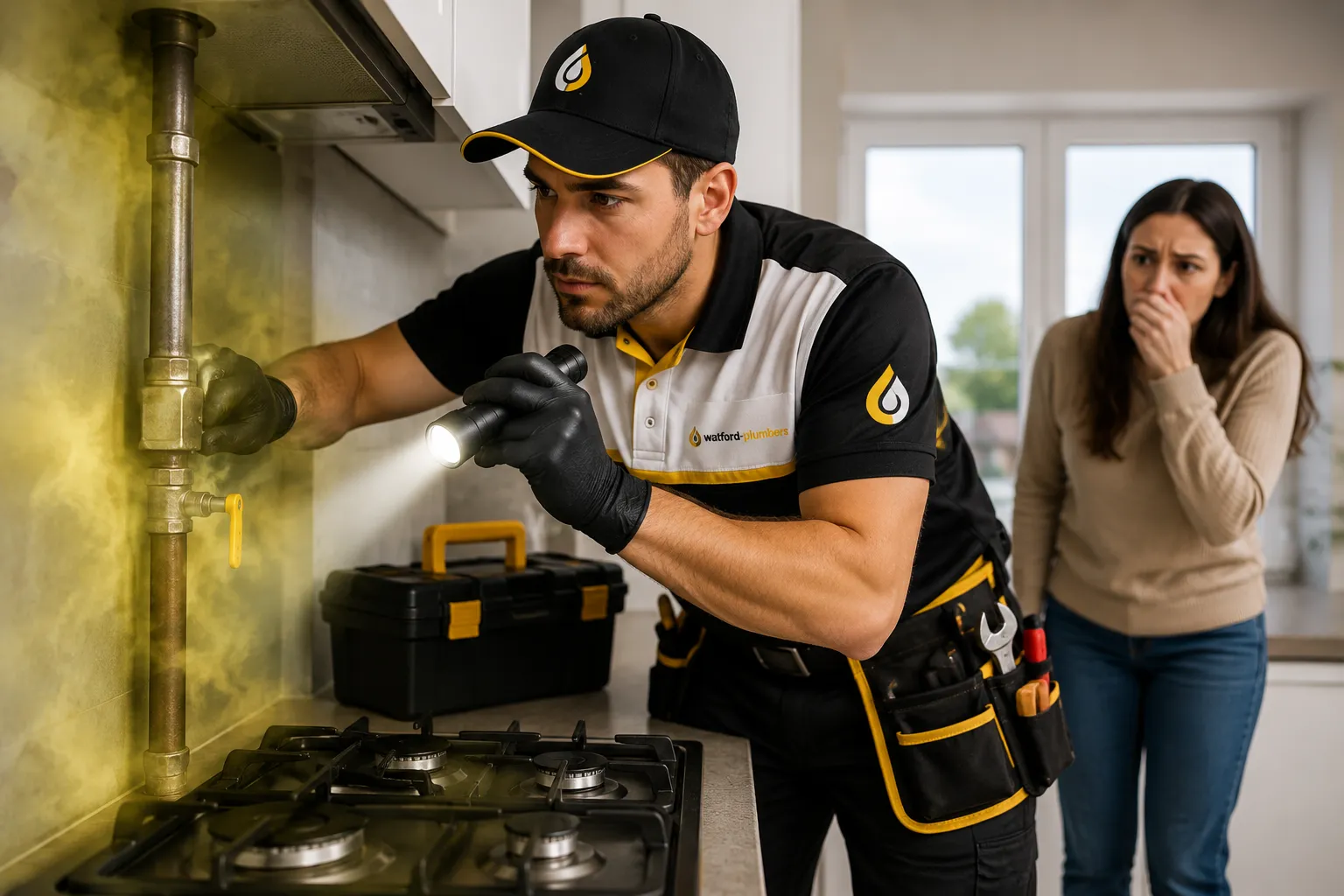
A tenant in an Edwardian conversion flat near Watford High Street, WD17, noticed a faint rotten egg smell near the kitchen cooker one evening. She left the property immediately and called the National Gas Emergency Service from a neighbour's house. Engineers found a corroded pipe joint behind the cooker within the hour, a fault that could have become far more serious if left over a weekend.
Watford Plumbers & Heating Engineers is Gas Safe registered under number 574111, and calls like this remind our team why speed and the right first steps matter more than anything else during a suspected gas leak.
This guide sets out exactly what a gas leak smells and sounds like, what to do the moment you notice it, and who to call for help.
Quick Answer
|
Featured Snippet -- Direct Answer |
|
If you smell gas at home, do not use light switches, phones, or naked flames. Open windows and doors, turn off the gas supply at the meter if it is safe to reach, leave the property, and call the National Gas Emergency Service on 0800 111 999 immediately from outside. |
What Does a Gas Leak Smell and Sound Like?
Natural gas is naturally odourless, so suppliers add a chemical called mercaptan, which produces the distinctive rotten egg or sulphur smell most people associate with a gas leak. Any sudden, unexplained version of this smell near your cooker, boiler, or gas meter should be treated seriously, even if it is faint.
A hissing or whistling sound near a pipe, meter, or appliance connection is another clear warning sign, often audible in a quiet room before the smell becomes obvious. Outdoors, watch for dead or unusually discoloured patches of grass or plants above buried gas pipework, or bubbles appearing in puddles or wet ground with no other explanation.
A gas smell is sometimes confused with drains, rotting food, or a neighbour's barbecue, which occasionally delays people from acting. The mercaptan smell added to gas is a genuinely distinctive rotten egg or sulphur note, sharper and more chemical than any of these, and it tends to be strongest near a cooker, boiler, or meter rather than spread evenly through a room. If you are ever unsure whether what you are smelling is gas, treat it as a leak rather than waiting to decide.
Common Causes of a Gas Leak at Home
Most home gas leaks in Watford trace back to ageing pipework, and Victorian and Edwardian properties in WD17 and Nascot Wood are more likely to have original or long-unserviced gas runs behind walls and under floors. Corroded joints, like the one found in the Watford High Street flat above, are a common failure point after decades of small movement and moisture exposure.

Appliance connections are another frequent cause. A damaged flexible hose behind a cooker, a loose fitting on a gas boiler, or pipework disturbed during unrelated DIY work, such as drilling into a wall, can all create a leak that was not present the day before. This is exactly why gas work is legally restricted to Gas Safe registered engineers under the Gas Safety (Installation and Use) Regulations 1998.
What to Do Immediately If You Smell Gas
The moment you suspect a gas leak, act in this order.
1. Do not operate any light switches, plug sockets, or doorbells on your way out, since even a small electrical spark can ignite escaping gas.
2. Open any windows and doors you pass to help the gas disperse.
3. If your gas meter has an accessible shut-off valve on your way out, turn it off, but do not delay your exit to search for it.
4. Leave the property completely, taking everyone with you.
5. Call the National Gas Emergency Service on 0800 111 999 once you are safely outside.
It is worth knowing where your gas meter is before you ever need to find it in a hurry. In most Watford terraces and semis it sits in an external meter box at the front of the property or just inside the front door in a hallway cupboard, while flats near Watford Junction often have a shared meter cupboard in a communal stairwell. Knowing this in advance means you are not searching for it while trying to leave quickly.
Mobile phones should stay switched off, or left running only if already on, until you are outside and clear of the property. Powering a phone on or off creates the same small spark risk as a light switch, so the safest approach is simply not to touch it at all while you are still inside.
What NOT to Do During a Suspected Gas Leak
Do not smoke, use a lighter, or create any naked flame anywhere near the property. Do not attempt to locate the source of the leak yourself by moving furniture or removing appliance panels, since this can disturb a fitting further and worsen the leak. Do not go back inside for belongings, pets, or to check on the smell again once you have left, even briefly.
|
Warning |
|
Never attempt to investigate, repair, or turn a gas supply back on yourself. Gas work is legally restricted to Gas Safe registered engineers, and disturbing a leak while trying to locate it can make a small fault dangerous very quickly. |
Who to Call and What Happens Next
The National Gas Emergency Service operates 24 hours a day, free of charge, and will send an engineer to make the situation safe, usually within an hour for a reported leak. If anyone is showing signs of a medical emergency, such as difficulty breathing, always call 999 as well.
Once on site, the attending engineer will test for gas, isolate the supply if a leak is confirmed, and advise whether it is safe to re-enter. A full repair must then be carried out by a Gas Safe registered engineer, since only qualified professionals are legally permitted to work on the gas installation itself.

Once an engineer confirms a leak, they will typically isolate the affected section, fit a warning tag to the meter or appliance, and explain what repair work is needed before gas can be safely restored. Never remove a warning tag or attempt to turn a supply back on yourself once an engineer has isolated it, even if the smell seems to have gone.
A gas smell outside your property, such as near a pavement, drain cover, or roadside gas main, should be reported the same way as an indoor leak. Cadent Gas maintains the local gas distribution network across Watford and Hertfordshire, and the National Gas Emergency Service number connects you to whichever network operator covers your area, so you never need to know which company to call.
If you rent your Watford property, report a suspected gas leak to your landlord or letting agent immediately, in addition to calling the National Gas Emergency Service yourself. Do not wait for permission to call the emergency number: gas safety is not something a tenant needs landlord approval to act on, and the same 0800 111 999 line applies to rented and owned homes alike.
Gas Leaks vs Carbon Monoxide: Know the Difference
Carbon monoxide is a completely different hazard from a gas leak, and it is worth knowing the difference. Escaping natural gas has the added mercaptan smell described above, whereas carbon monoxide is entirely colourless and odourless, produced when gas does not burn completely inside a faulty appliance. This is why a working carbon monoxide alarm is essential everywhere a gas appliance is used, since your nose alone will not detect it.
|
Signal |
Gas Leak |
Carbon Monoxide |
|
Smell |
Rotten egg / sulphur (mercaptan added) |
None -- completely odourless |
|
Detection |
Human nose, hissing sound |
CO alarm only |
|
Symptoms |
None directly -- fire and explosion risk |
Headache, dizziness, nausea, confusion |
|
Immediate action |
Evacuate, no switches, call 0800 111 999 |
Evacuate, ventilate, call a Gas Safe engineer, or 999 if severe |
|
Regulation |
Gas Safety (Installation and Use) Regulations 1998 |
Same regulations; CO alarm is best practice |
The symptoms also differ. A gas leak itself causes no direct physical symptoms; its danger is fire and explosion risk, while carbon monoxide poisoning causes headaches, dizziness, nausea, and confusion that can worsen the longer exposure continues. Our guide to carbon monoxide poisoning signs and boiler safety covers CO-specific symptoms and alarm placement in full detail.
How to Prevent a Gas Leak at Home
Preventing a gas leak starts with an annual Gas Safe service for your boiler and any other gas appliances, which checks pipework, joints, and connections before small faults become dangerous ones. Watford landlords must also arrange a CP12 gas safety certificate every 12 months under the Gas Safety (Installation and Use) Regulations 1998, which covers exactly this kind of pipework and appliance check on rented properties.
Fit a carbon monoxide alarm near every gas appliance, test it monthly, and never attempt to repair, move, or extend gas pipework yourself, even for a seemingly simple job. Always check that any engineer working on gas in your home carries a valid Gas Safe ID card before they start.
A flexible gas hose behind a cooker has a manufacturer-recommended replacement date, usually printed on the fitting itself, and swapping it before it perishes is a simple way to prevent one of the most common appliance-level leaks. Ask your engineer to check hose condition as part of any annual service rather than waiting for a visible crack to appear.
Conclusion
Knowing the smell, the sound, and the correct order of steps, leave first, call second, never investigate yourself, is the single most useful piece of gas safety knowledge any Watford household can have. A fast, calm response in the first minute after noticing a gas leak is what keeps a serious fault from becoming a genuine emergency.
If you have any doubt at all about a gas smell in your home, always treat it as a leak and follow the steps above. Watford Plumbers & Heating Engineers can also carry out your annual gas safety check or CP12 certificate before a small fault ever becomes a dangerous one.
|
Get Help |
|
Smelling gas right now? Leave the property and call the National Gas Emergency Service on 0800 111 999. For a Gas Safe registered annual service or CP12 certificate, call Watford Plumbers & Heating Engineers on 07425 281 744. |
Frequently Asked Questions
What does a gas leak smell like?
A gas leak smells like rotten eggs or sulphur, caused by mercaptan, a chemical added to naturally odourless gas so leaks can be detected by smell. The scent is usually strongest near a cooker, boiler, or meter. Treat any unexplained version of this smell as a genuine leak.
Is it safe to open windows during a gas leak?
Yes, opening windows and doors as you leave helps gas disperse and reduces the concentration inside the property. Do this quickly on your way out rather than stopping to open every window in the house, and never delay leaving in order to ventilate the property fully.
Should I turn off my gas meter if I smell gas?
Only if the shut-off valve is easily accessible on your way out of the property. Do not search for it or delay your exit to find it. Leaving safely and calling the National Gas Emergency Service matters more than reaching the meter.
What number do I call for a gas leak in the UK?
Call the National Gas Emergency Service on 0800 111 999, available 24 hours a day, free of charge, from anywhere in the UK. If anyone is showing signs of a medical emergency, such as difficulty breathing, call 999 as well.
Can a gas leak make you feel unwell?
A gas leak itself does not usually cause direct symptoms, its main danger is fire and explosion risk. Feeling unwell, with headaches, dizziness, or nausea, is more likely a sign of carbon monoxide poisoning, which needs a working CO alarm to detect.
