
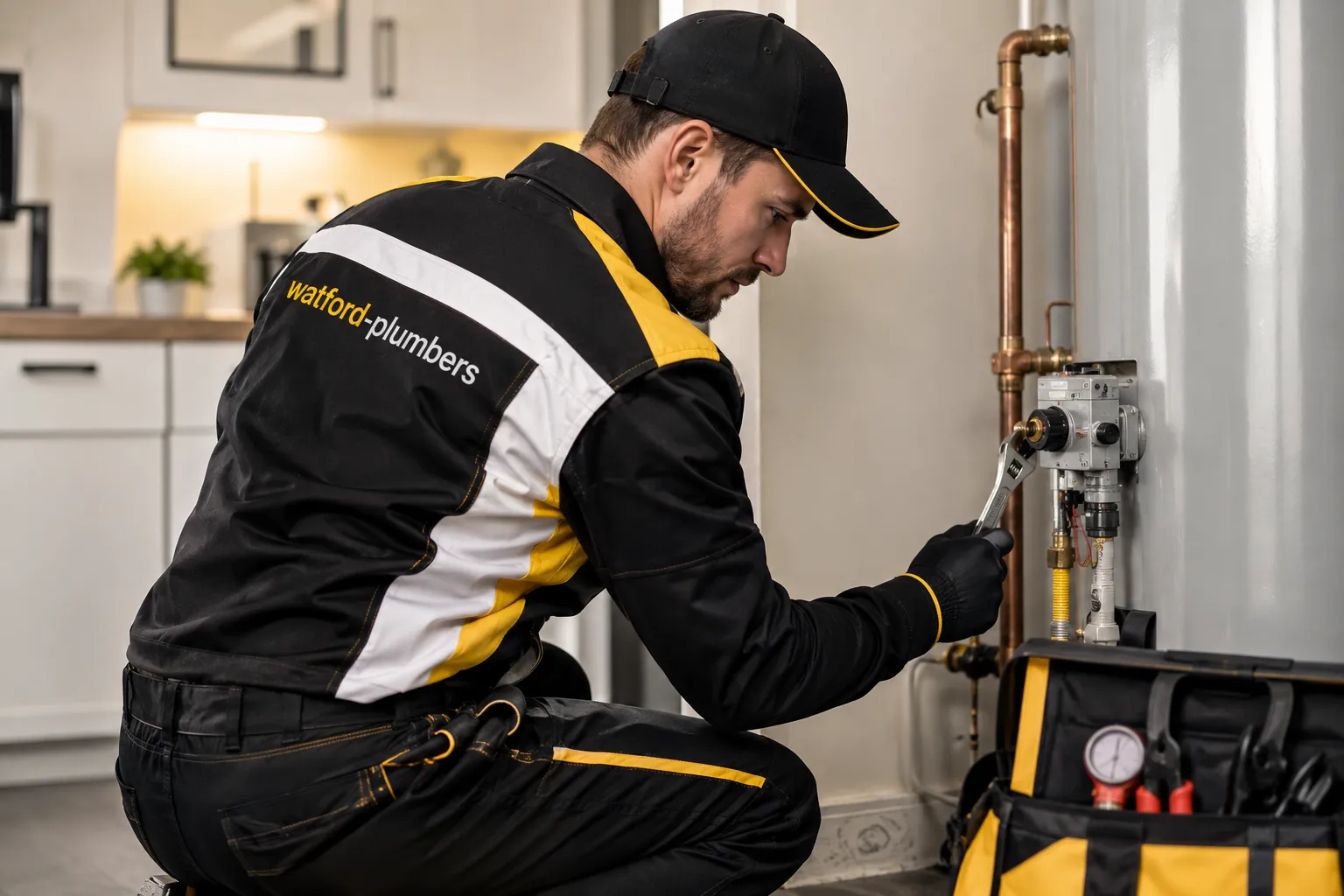
A retired couple in a 1930s semi in Oxhey, WD19, turned on the shower one morning to find only cold water, even though the radiators had been warm the night before. With a hospital appointment booked for later that morning, working out the cause quickly mattered more than usual.
Watford Plumbers & Heating Engineers sees this exact pattern, heating fine but no hot water, or the reverse, more often than almost any other callout. Most cases trace back to one of eight causes, and several are safe to check yourself before calling an engineer.
This guide walks through each of the eight causes in the order most likely to affect a Watford home, with the fix for each one and a clear line on when the job needs a Gas Safe engineer.
Quick Answer
|
Featured Snippet -- Direct Answer |
|
No hot water is usually caused by a low pilot light, low boiler pressure, a faulty diverter valve, an airlock, a tripped immersion heater, or limescale from hard water. Check the pressure gauge and pilot light first. If heating also fails, or a fault code appears, call a Gas Safe engineer. |
Is It No Hot Water Only, or No Heat Too?
Whether your heating is still working tells you a great deal before you check anything else. If both heating and hot water have stopped together, the fault usually sits with the boiler itself, low pressure, a lockout code, or a pilot light issue, rather than anything specific to the hot water side.
If your radiators are warm but only the hot water has failed, the cause is more likely a component that serves hot water specifically. On a combi boiler this usually points to the diverter valve, the part that switches the boiler between heating mode and hot water mode. On an older system with a hot water cylinder, common in Victorian and Edwardian conversions in Nascot Wood, an immersion heater fault is the more likely candidate.
8 Causes of No Hot Water in Watford Homes (and How to Fix Each One)
Here is a quick reference before the detailed causes below. Match your symptom to the likely cause, then read the full explanation and fix.
|
Cause |
DIY or Engineer |
Quick Fix |
|
1. Pilot light out |
DIY (usually) |
Relight per manual; call an engineer if it won't stay lit |
|
2. Low boiler pressure |
DIY |
Top up via filling loop to 1.0-1.5 bar |
|
3. Thermostat/programmer wrong |
DIY |
Check hot water schedule and thermostat setting |
|
4. Faulty diverter valve |
Engineer |
Valve replacement inside the boiler casing |
|
5. Airlock in pipework |
DIY |
Run the furthest hot tap, or bleed radiators |
|
6. Frozen condensate pipe |
DIY (usually) |
Thaw with warm water, then reset the boiler |
|
7. Immersion heater fault |
DIY reset / Engineer for element |
Reset switch once; replace element if it fails again |
|
8. Limescale (hard water) |
Engineer |
Descale the element, or book a power flush |
1. Pilot Light Has Gone Out
The pilot light is the small permanent flame that ignites your boiler's main burner on older, non-combi boilers. A draught, a build-up of dust, or a fault in the thermocouple can cause it to go out. Relighting it is usually straightforward and explained in your boiler's manual, but if it will not stay lit after two or three attempts, the thermocouple itself has likely failed and needs a Gas Safe engineer.
To relight a pilot light safely, always follow the exact sequence printed on a label inside the boiler casing or in your manual, since the order of turning the gas control knob and holding the ignition button matters. If you cannot find the instructions or the flame will not catch after two attempts, stop and call an engineer rather than repeating the process indefinitely.
2. Low Boiler Pressure
Boiler pressure below around 1.0 bar can stop hot water production even though the boiler otherwise appears to be working. Check the pressure gauge, and if it reads low, top it up yourself using the filling loop following your manual's instructions. If pressure keeps dropping again within days, there is likely a small leak elsewhere in the system that needs investigating.
Pressure that drops gradually over several weeks, rather than all at once, usually points to a slow leak at a radiator valve or pipe joint somewhere in the system, which is worth mentioning to your engineer even if a single top-up temporarily solves the immediate problem.
3. Thermostat or Programmer Set Wrong
It sounds obvious, but a programmer switched to an "off" period, or a hot water thermostat turned down too low, is a genuinely common false alarm. Check both settings before assuming a fault, particularly after a power cut, which can reset some programmer clocks and schedules.
Modern combi boilers often use a digital programmer with separate heating and hot water schedules, and it is easy to accidentally adjust the wrong one when changing a single setting. If you have recently changed clocks for daylight saving or had a power cut, check both schedules rather than assuming the fault lies elsewhere.
4. Faulty Diverter Valve
The diverter valve directs water either to your radiators or to your hot water outlets on a combi boiler. When it sticks, usually due to limescale or general wear, you can lose hot water while heating still works, or the reverse. This is not a DIY repair. The valve sits inside the boiler casing and needs a Gas Safe engineer to replace it correctly.
A failing diverter valve often shows a specific pattern before it fails completely: hot water that runs warm rather than hot, or a delay of several seconds before hot water reaches temperature. Mentioning this detail to your engineer when you call helps them bring the right replacement part on the first visit.
5. Airlock in the Pipework
Air trapped in the pipework can block hot water reaching a tap, particularly after any recent plumbing work or a period with the system drained down. Try running the hot tap furthest from the boiler for a minute to help clear a minor airlock. If this does not help within a few attempts, the air may be trapped closer to the boiler itself and needs a professional bleed.
Airlocks are more likely after any work draining the system, such as replacing a radiator or repairing a leak. If bleeding the furthest tap does not help, bleeding radiators the same way you would to fix a cold spot can sometimes resolve the same air pocket.
6. Frozen Condensate Pipe
In cold weather, a frozen external condensate pipe can trigger a boiler lockout that stops both heating and hot water. Thaw the pipe with warm water, never boiling, then reset the boiler. Our guide to what to do when your boiler breaks down in winter covers this cause and several others specific to cold weather in full detail.
7. Immersion Heater Fault
If your Watford home has a hot water cylinder rather than a combi boiler, a tripped immersion heater switch or a failed heating element is a common cause of no hot water with everything else appearing normal. Check the switch, usually near the airing cupboard, and reset it once. A repeated trip or no improvement after resetting points to a failed element, which needs replacing rather than resetting again.
The immersion heater switch is usually a small red switch near the airing cupboard or hot water cylinder, clearly separate from your main consumer unit. Resetting it more than once without success, or noticing a burning smell, means the heating element itself has likely failed and should not be reset again until a professional has checked it.
8. Limescale on the Heat Exchanger (Hard Water)
Watford's hard water leaves limescale deposits inside heat exchangers, immersion heater elements, and hot water cylinders over time, gradually reducing how efficiently they heat water until hot water becomes patchy or stops altogether. This is more common in older Nascot Wood and central Watford properties that have never had a power flush. Descaling or a full power flush restores normal heating, and a water softener can slow future scale build-up considerably.
Descaling an immersion element or heat exchanger removes existing limescale, while a power flush clears accumulated sludge and scale from the entire central heating system, including radiators and pipework, not just the boiler itself. Both are worth discussing with your engineer if hot water has become slow to heat or noticeably less consistent over the past year.
When to Call a Gas Safe Engineer Instead of DIY
Call a Gas Safe engineer immediately if you smell gas, if the pilot light will not stay lit after a couple of attempts, if a fault code returns after resetting the boiler, or if the cause points to the diverter valve, immersion heater element, or heat exchanger. Attempting gas work without Gas Safe registration is a criminal offence under the Gas Safety (Installation and Use) Regulations 1998, so component-level repairs inside the boiler casing are never a DIY job.

How to Avoid Losing Hot Water Again
Booking an annual boiler service catches a failing diverter valve, a worn immersion element, or early limescale build-up before they cause a complete loss of hot water. A power flush every few years is worth considering in Watford specifically, given how hard the local water supply is, and helps protect both the heat exchanger and any hot water cylinder from scale damage.
No Hot Water in a Rented Watford Property: What to Do
If you rent your Watford property, report a loss of hot water to your landlord in writing as soon as it happens. Under the Landlord and Tenant Act 1985 Section 11, landlords must keep the water heating installation in proper working order, and a total loss of hot water is generally treated as an emergency repair that should not wait weeks for a routine appointment slot.

Conclusion
Most causes of no hot water fall into one of these eight categories, and working through them in order, checking pressure and pilot light before assuming a bigger fault, saves both time and an unnecessary engineer callout. Watford's hard water adds an extra layer of risk here that softer-water areas of the UK do not face to the same degree.
If you have checked the simple causes above and hot water still has not returned, Watford Plumbers & Heating Engineers can diagnose and fix the fault, from a stuck diverter valve to a full power flush.
|
Get Help |
|
No hot water and not sure why? Call Watford Plumbers & Heating Engineers on 07425 281 744 for a diagnosis and same-day repair across WD17 to WD25. |
Frequently Asked Questions
Why do I have hot water but no heating (or vice versa)?
This usually points to a fault specific to one side of the system rather than the boiler as a whole. On a combi boiler, a stuck diverter valve is the most common cause. On a system with a hot water cylinder, an immersion heater or cylinder thermostat fault is more likely.
Is low boiler pressure the same as no hot water?
Low pressure is one of several possible causes, not a separate problem. Check your pressure gauge first, since it reads between 1.0 and 1.5 bar normally. If it is low, topping it up via the filling loop often restores hot water within minutes.
Can I fix a diverter valve myself?
No, a diverter valve sits inside the boiler casing and requires specialist tools and Gas Safe registration to access and replace safely. Attempting this yourself risks damaging the boiler further and is not permitted under UK gas safety regulations for anyone without registration.
Why does my hot water only last a few minutes?
This is often a sign of limescale reducing your heat exchanger or cylinder's efficiency, particularly in Watford's hard water area, or a thermostat set too low. A power flush or descale usually resolves persistent short-lived hot water rather than a full component replacement.
Should my landlord fix no hot water urgently?
Yes, under the Landlord and Tenant Act 1985 Section 11, landlords must keep water heating in proper working order, and a total loss of hot water is generally treated as an emergency repair. Report it in writing and expect a prompt response, not a routine appointment slot.
